
What to consider when building your Amazon Team
Amazon has solidified its position as the world’s ultimate digital shopping destination. With over 310 million active customers and a staggering 37.6% of the U.S. e-commerce market share, the platform represents an unparalleled opportunity for brands to connect with a global audience. More consumers now begin their product research on Amazon than on Google, making a strong presence on the platform essential for brand visibility and growth, regardless of whether you sell directly on the marketplace.
However, navigating the complexities of the Amazon ecosystem is a significant challenge for many businesses. The platform’s self-service model, combined with its constantly evolving algorithms and operational requirements, demands a specialized and multi-disciplinary approach. While the ideal scenario involves a dedicated Amazon team of experts managing various workflows, many brands struggle to allocate the necessary resources, often leading to missed opportunities and an inability to compete effectively.
This article provides a comprehensive guide to building a high-performing Amazon team. We will explore the critical roles and responsibilities required for success, analyze the data-driven strategies that separate top performers from the rest, and provide actionable insights to help you structure your team for scalable growth. By understanding the key functions—from strategic account management to operational excellence—you can build a team that not only navigates the challenges of the marketplace but also capitalizes on its immense potential.

The Strategic Pillar: Commercial Lead / Account Manager
At the heart of any successful Amazon operation is a strategic leader who can steer the ship. The Commercial Lead or Amazon Account Manager is responsible for the overall vision, strategy, and financial performance of the Amazon channel. This role is not merely administrative; it is a high-stakes position that demands a deep understanding of both e-commerce and business management.
The primary responsibilities of a Commercial Lead include setting the strategic direction, owning the profit and loss (P&L) for the Amazon account, managing forecasting and budgets, and reporting performance to senior stakeholders. This individual must be able to analyze complex data sets, identify growth opportunities, and delegate tasks effectively across a multi-disciplinary team. Given the strategic importance of this role, experienced professionals are highly sought after and command significant salaries, with compensation packages for senior roles at Amazon ranging from $127,000 to over $431,000 annually.
Many brands make the mistake of assigning Amazon responsibilities to a national account manager who also handles other major retailers. While this may seem cost-effective, it often results in a lack of focus and a failure to capitalize on Amazon’s unique growth levers. The platform’s complexity requires dedicated attention, and brands that treat it as just another retail account risk under-indexing and falling behind more focused competitors.
Key Responsibilities:
- Strategic Planning: Defining long-term goals and the roadmap to achieve them.
- Financial Ownership: Managing the P&L, budgeting, and forecasting.
- Performance Reporting: Communicating results and insights to leadership.
- Team Leadership: Delegating tasks and coordinating cross-functional efforts.
At Push-Pull Amazon agency, our Amazon Account Managers deliver best-in-class support through strategic planning, robust analytics and reporting, and operational excellence, helping your brand grow and succeed on Amazon.
The Engine Room: Account Support
While the Commercial Lead sets the strategy, the Account Support function executes the day-to-day tasks that keep the Amazon business running smoothly. This role is the engine room of the operation, responsible for a wide range of critical administrative and operational duties. Without effective account support, even the best strategies will falter due to poor execution and unresolved issues.
Key responsibilities include managing product listings, uploading new line forms, creating and managing support cases with Amazon, and uploading content such as images and A+ Content. These tasks, while seemingly straightforward, are often time-consuming and require a deep understanding of Amazon’s Seller Central or Vendor Central interfaces. The platform’s frequent changes and occasional glitches mean that a persistent and detail-oriented approach is essential for success.
Many businesses underestimate the workload involved in this function, often assigning these tasks to the Account Manager or a general administrative team with a much wider remit. This approach frequently leads to significant bottlenecks, longer lead times for critical tasks, and a reactive, fire-fighting approach to problem-solving. A dedicated Account Support specialist, or team, ensures that the operational tempo is maintained, allowing the Commercial Lead to focus on strategic initiatives rather than getting bogged down in administrative details.
Key Responsibilities:
- Listing Management: Creating, updating, and troubleshooting product listings.
- Case Management: Raising and resolving support cases with Amazon.
- Content Uploads: Publishing images, videos, and A+ Content.
- Issue Resolution: Fixing suppressed listings and other operational problems.
Our Account Support Team provides end-to-end catalogue management, proactive issue resolution, and reliable operational support to keep your Amazon account performing at its best.
The Visibility Engine: Amazon SEO & Traffic
In the crowded Amazon marketplace, visibility is paramount. Amazon Search Engine Optimization (SEO) is the practice of optimizing product listings to rank higher in search results, and it is arguably the most critical factor for driving organic traffic and sales. While household brand names have an inherent advantage, a sophisticated Amazon SEO strategy can enable even private label sellers to compete and win against established giants.
At the core of Amazon search is the A9 algorithm, a complex system designed with a single objective: to present customers with the products they are most likely to purchase. Unlike Google, which prioritizes informational content, Amazon’s algorithm is transaction-focused. It analyzes a multitude of factors to determine a product’s relevance and performance history. Research shows that 63% of consumers start their product search on Amazon, bypassing traditional search engines entirely, which underscores the importance of mastering the A9 algorithm.
Key Ranking Factors of the A9 Algorithm
The A9 algorithm’s ranking decisions can be broadly categorized into two areas: relevance and performance:
Relevance
- Product Title: The most heavily weighted factor. Must include top keywords.
- Backend Keywords: Hidden keywords that help the algorithm understand the product.
- Bullet Points & Description: Detailed, keyword-rich copy that highlights features and benefits.
- Brand Name: Consistent branding can improve visibility.
Performance
- Sales Velocity: The rate and volume of sales are powerful indicators of a product’s popularity.
- Click-Through Rate (CTR): A high CTR from search results signals relevance.
- Conversion Rate: The percentage of visitors who make a purchase. Amazon’s average conversion rate is a staggering 9.5-10%.
- Customer Reviews: The quantity and quality of reviews significantly impact trust and conversions.
- Price: Competitive pricing is crucial for winning the “Buy Box” and driving sales.
Despite the critical importance of SEO, most brands lack the dedicated resources or expertise to implement a robust strategy. Keyword research should be conducted for every product and continuously monitored and refined based on performance data. Brands that invest in Amazon SEO consistently achieve higher visibility across the most valuable keywords in their categories, creating a sustainable competitive advantage.
Our SEO specialists provide end-to-end search engine optimisation, including keyword research, competitor analysis, content optimisation, and performance tracking, to improve rankings and drive qualified organic traffic.
The Growth Accelerator: Amazon Advertising
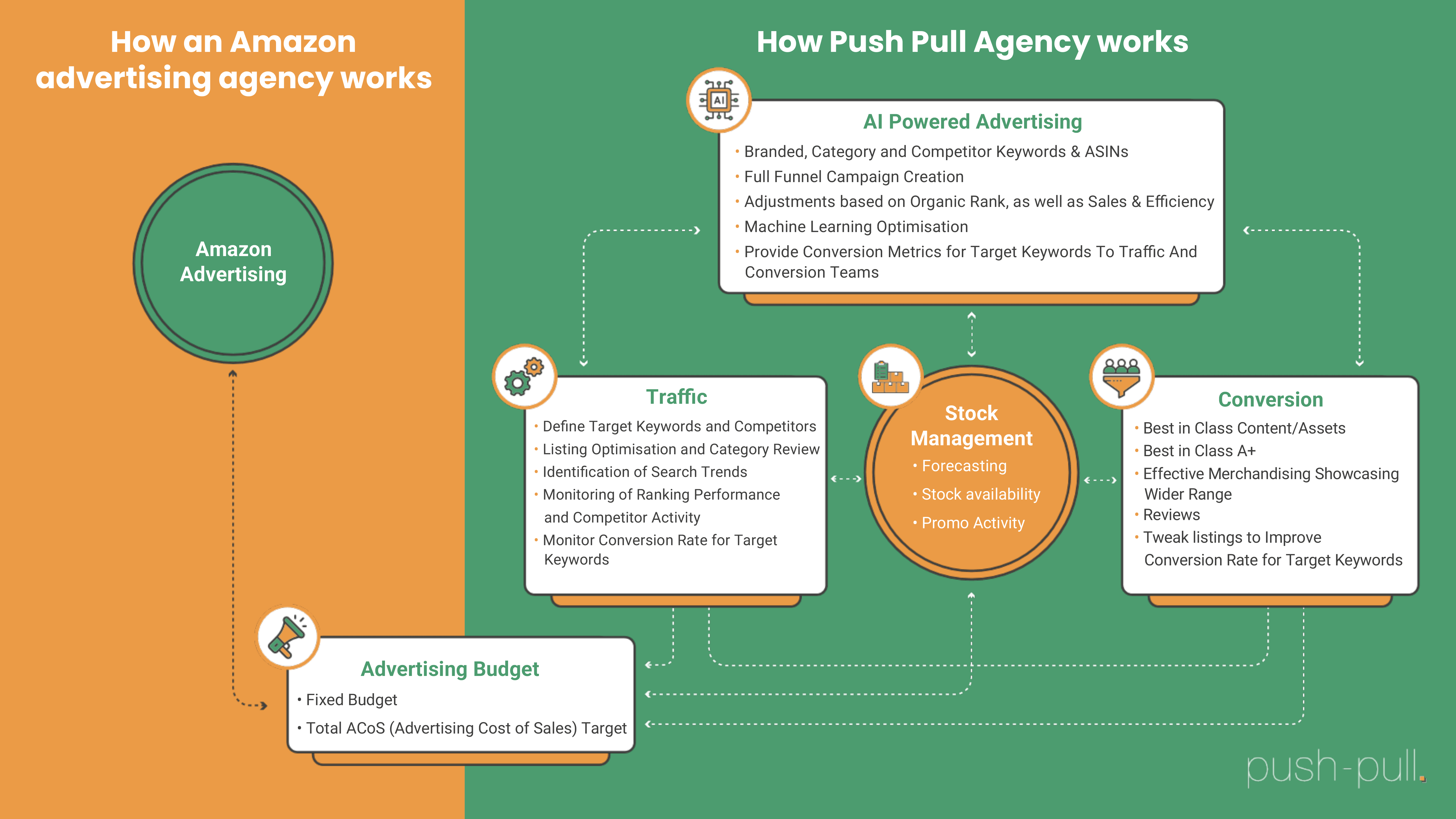
While a strong SEO foundation is essential for organic visibility, Amazon Advertising is the primary tool for accelerating growth, defending market share, and reaching new customers. In 2024, Amazon’s advertising revenue approached $45 billion, a testament to its effectiveness and the increasing investment from brands. A well-managed advertising strategy is no longer optional; it is a critical component of a successful Amazon business.
Amazon’s advertising platform, primarily driven by Pay-Per-Click (PPC) models like Sponsored Products, Sponsored Brands, and Sponsored Display, offers a powerful suite of tools to influence the customer journey. It allows brands to protect their digital shelf space from competitors, target shoppers with specific interests, and drive incremental sales. The average cost-per-click (CPC) on Amazon in 2025 is approximately $1.04, and with average conversion rates hovering between 9.5% and 10%, the return on investment can be substantial when managed effectively.
An ideal advertising strategy is deeply integrated with the brand’s overall Amazon and business objectives. The advertising team should work in close collaboration with the SEO and content teams to ensure that campaigns are aligned with organic keyword strategies and that landing pages are optimized for conversion. This synergy creates a virtuous cycle: advertising drives traffic and sales, which in turn improves organic ranking, leading to a lower overall reliance on paid media over time.
However, many brands struggle to manage their Amazon advertising effectively. The options are often to manage it in-house, which requires costly and experienced resources, or to outsource it to a specialized agency. While agencies can provide expertise, they are often disconnected from the day-to-day operations and strategic context of the business, leading to a one-dimensional approach that focuses solely on ad metrics rather than overall business growth.
Key Advertising Functions:
- Campaign Management: Creating, monitoring, and optimizing PPC campaigns.
- Keyword & Audience Targeting: Identifying and targeting relevant customer segments.
- Budget Allocation: Managing ad spend to maximize return on investment (ROI).
- Performance Analysis: Reporting on key metrics such as ACoS (Advertising Cost of Sale), ROAS (Return on Ad Spend), and overall profitability.
Our Advertising Team drives targeted campaigns, optimises ad performance, and leverages data-driven strategies to maximise your ROI and elevate your brand visibility.
The Persuasion Expert: Conversion Specialist & Asset Creation
Driving traffic to a product listing is only half the battle; converting that traffic into sales is where the real value is created. This is the domain of the Conversion Specialist, a role dedicated to optimizing every element of the product detail page to maximize the conversion rate. While the average e-commerce conversion rate hovers around 2-3%, Amazon’s platform average is a remarkable 9.5-10%, and for Prime members, it can be even higher. A skilled Conversion Specialist can push this rate even further, directly impacting sales and profitability.
This role focuses on a continuous cycle of analysis, testing, and refinement. The specialist uses a variety of data sources, including Brand Analytics, Search Query Performance reports, and competitor analysis, to understand customer behavior and identify areas for improvement. They are responsible for crafting compelling listing copy, optimizing images and videos, and developing robust A+ Content to create a best-in-class customer experience.
The Power of A+ Content and High-Quality Assets
A+ Content (and its more advanced counterpart, Premium A+ Content) is a powerful tool for enhancing product detail pages with rich media and detailed information. It allows brands to tell their story, showcase product features, and build trust with customers. According to Amazon, implementing Basic A+ Content can increase sales by up to 8%, while well-executed Premium A+ Content can boost sales by as much as 20%. A case study with the brand Safariland demonstrated a 37% increase in conversions after a thorough listing optimization project that included A/B testing of their content.
High-quality visual assets are another critical component of conversion. The Conversion Specialist works closely with graphic designers and photographers to produce a suite of images and videos that not only meet Amazon’s technical requirements but also effectively communicate the product’s value proposition. This includes lifestyle images, infographics, and videos that demonstrate the product in use.
Despite its proven impact on the bottom line, the Conversion Specialist role is one of the rarest to find in in-house Amazon teams. In many organizations, listing adjustments are made on an ad-hoc basis, without a data-driven strategy or rigorous monitoring. This reactive approach leaves significant money on the table and cedes a competitive advantage to more sophisticated sellers.
Key Conversion-Focused Activities:
- A/B Testing: Experimenting with different titles, images, and copy to identify what resonates with customers.
- Content Optimization: Crafting and refining product descriptions, bullet points, and A+ Content.
- Review Management: Monitoring and responding to customer reviews and questions.
- Asset Creation: Directing the production of high-quality images, videos, and other creative assets.
The Foundation of Profitability: Operations
An often-overlooked but critical function within any Amazon business is Operations. This area deals with the logistical and financial complexities of trading with Amazon, and it forms the foundation upon which profitability is built. Without a strong operational team or process, brands can see their hard-earned revenue eroded by chargebacks, penalties, and inventory-related issues. As one of the top five challenges for sellers using Fulfillment by Amazon (FBA), effective inventory management is crucial for success.
Amazon’s operational standards are notoriously strict, and non-compliance can result in a variety of financial penalties known as chargebacks or deductions. These can be issued for anything from incorrect packaging to late shipments. According to guidance for vendors, there is a limited 30-day window to dispute these charges, yet many large brands find the process so complex that they simply write off significant sums of money rather than tackling the issues head-on. A dedicated operations specialist understands the dispute process and can recover substantial revenue that would otherwise be lost.
Common Operational Challenges:
- Chargeback and Deduction Management: Identifying, disputing, and resolving financial penalties from Amazon.
- Inventory Management: Preventing stockouts, managing excess inventory, and avoiding long-term storage fees.
- Stranded Inventory: Resolving issues that cause inventory to become unsellable, such as listing errors or SKU mismatches.
- Shipment Reconciliation: Ensuring that all units sent to Amazon’s fulfillment centers are correctly received and accounted for.
Having a team member who understands the nuances of Amazon’s supply chain and financial reconciliation processes is a rare but invaluable asset. This individual can implement the systems and processes needed to minimize operational issues and ensure that the business is running as efficiently and profitably as possible.
Conclusion: Assembling Your A-Team for Amazon Success
Building a successful business on Amazon is not a matter of chance; it is the result of a strategic, well-resourced, and integrated approach. The platform’s immense scale, with its 9.7 million sellers and fiercely competitive landscape, demands a level of specialization that goes far beyond what most brands initially anticipate. As we have seen, success requires a multi-disciplinary team where each member plays a distinct and vital role.
From the strategic oversight of the Commercial Lead to the meticulous execution of the Account Support team, and from the visibility-driving efforts of the SEO and Advertising specialists to the revenue-maximizing focus of the Conversion and Operations experts, each function is a critical piece of the puzzle. Neglecting any one of these areas creates a vulnerability that competitors will inevitably exploit.
For many brands, the primary obstacle is not a lack of ambition but a failure to invest in the right talent and structure. The data is clear: specialized expertise in areas like SEO, advertising, and conversion optimization delivers a significant return on investment. Brands that attempt to manage Amazon with a skeleton crew or as a secondary responsibility for an already overstretched team are fundamentally limiting their growth potential.
Whether you choose to build these capabilities in-house, partner with a specialized agency, or use a hybrid model, the key is to recognize that winning on Amazon requires a dedicated, data-driven, and fully integrated team. By investing in the right people and processes, you can transform your Amazon channel from a complex operational challenge into a powerful engine for sustainable growth and profitability.
Choosing Your Amazon Team Resource
As you manage your Amazon business, you may need some support along the way. Push-Pull can plug their expert Amazon resource into any brand to make them best-in-class
We treat each of our accounts like we do our own company: by providing top-notch service that increases sales. We help clients analyse consumer data and access professional marketing strategies. Contact Push Pull today to learn more.


Frequently Asked Questions (FAQ)
Q1: What are the most important roles for a successful Amazon team?
A successful Amazon team requires a multi-disciplinary approach covering six key areas: a strategic Commercial Lead/Account Manager to guide the overall strategy, Account Support for daily operations, an Amazon SEO Specialist to drive organic traffic, an Advertising Manager to accelerate growth through PPC, a Conversion Specialist to optimize listings and create assets, and an Operations Specialist to manage inventory and profitability.
Q2: How can I improve my product ranking on Amazon?
Improving your product ranking on Amazon involves optimizing for the A9 algorithm. This means focusing on two main areas: relevance and performance. Enhance relevance by using targeted keywords in your product title, bullet points, description, and backend search terms. Boost performance by driving sales velocity (through advertising and promotions), improving your click-through and conversion rates, generating positive customer reviews, and ensuring your product is always in stock.
Q3: Is Amazon A+ Content worth the investment?
Yes, the data shows that A+ Content provides a significant return on investment. According to Amazon, implementing Basic A+ Content can increase sales by up to 8%, while Premium A+ Content can lead to a sales lift of as much as 20%. It enhances the customer experience, improves conversion rates, and helps your brand stand out from the competition.
Q4: What is a common mistake brands make when managing their Amazon channel?
A common mistake is under-resourcing the channel. Many brands assign Amazon duties to a general sales or marketing team member who lacks the specialized knowledge required to navigate the platform’s complexities. This often leads to a reactive, unfocused approach that fails to capitalize on growth opportunities and leaves the brand vulnerable to more dedicated competitors.